Projects · India
AI & Computer Vision
Custom computer vision pipelines for manufacturing quality inspection, parking occupancy analytics, and ANPR enhancement under challenging Indian lighting and plate conditions. Multiplexer Solution packages models for edge GPUs and cloud batch processing with MLOps-friendly versioning and drift monitoring. Deliverables integrate with existing operational dashboards rather than standalone silos.
Overview
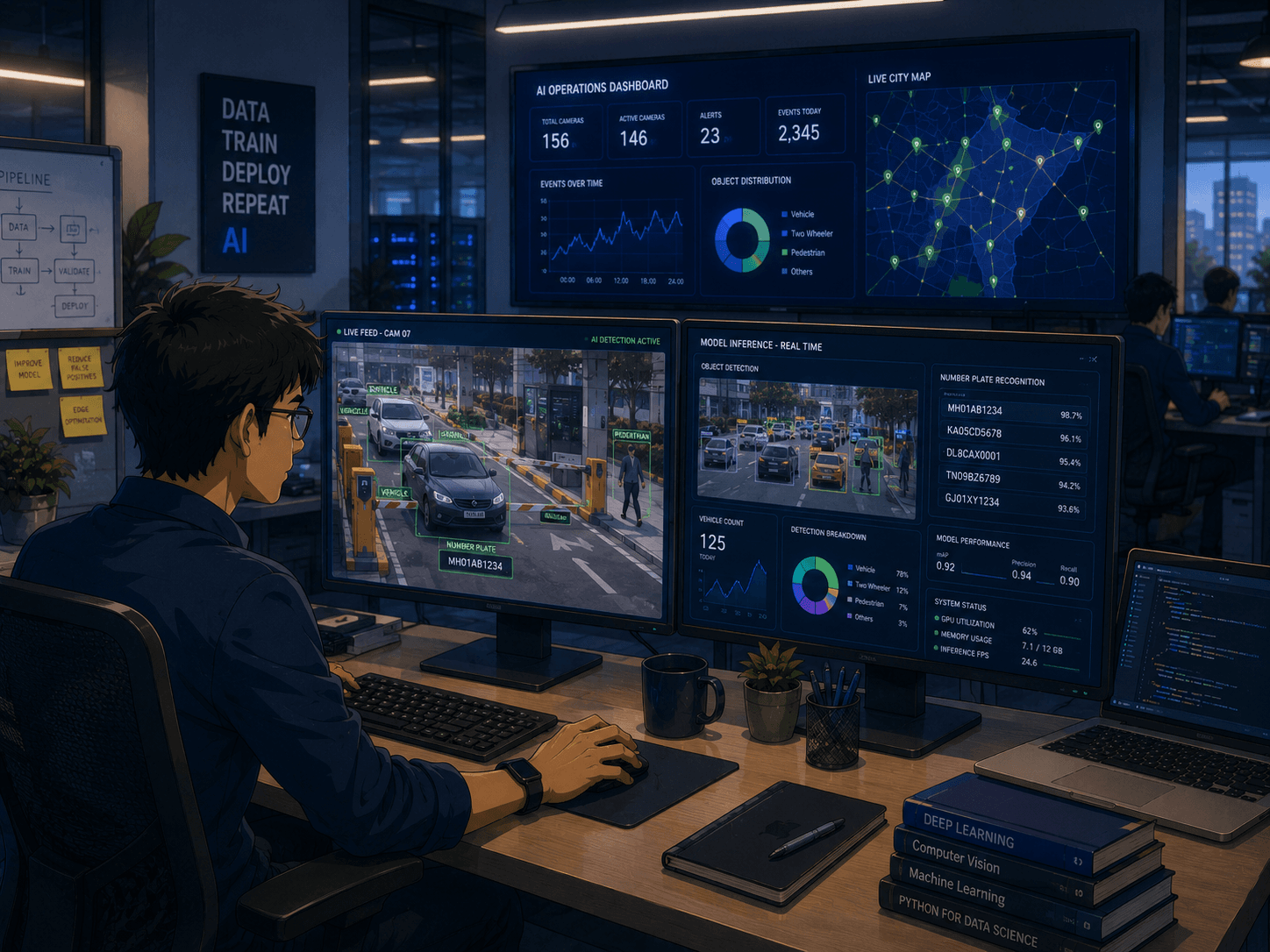
The AI & Computer Vision practice at Multiplexer Solution builds production-grade vision systems—not slide-deck prototypes—for clients who need repeatable inference at scale. Engagements span defect detection on assembly lines, bay occupancy from overhead cameras, and ANPR refinement for glare, mud, and non-standard plate mounts common on Indian vehicles.
Each pipeline includes data labeling guidelines, training recipes, evaluation harnesses, and deployment manifests for NVIDIA Jetson-class edge devices or centralized GPU workers. Outputs feed Parkadda parking analytics and third-party MES/SCADA systems through documented APIs.
Business context
Manual visual inspection is slow, subjective, and difficult to audit. Parking operators relying on single ANPR vendors often see elevated manual reviews during monsoon glare or night-time headlight bloom. Manufacturers face scrap costs and warranty exposure when defects escape final QA.
Vision AI reduces rework, standardizes pass/fail criteria, and produces timestamped evidence for compliance. When paired with Parkadda, improved plate reads directly translate to fewer gate interventions and higher automated payment capture.
Scope & deliverables
Data & modeling
- Dataset curation, labeling SOPs, and train/val/test splits with leakage controls
- Model selection (detection, segmentation, classification) aligned to latency budgets
- Benchmark reports with precision/recall curves and confusion analysis by class
Deployment & operations
- Edge or cloud inference services with health checks and rolling model updates
- Integration SDKs and webhooks for alarms, annotated frames, and KPI feeds
- Runbooks for retraining triggers when drift detectors exceed thresholds
Technical architecture
Python services orchestrate training in TensorFlow with OpenCV preprocessing pipelines tuned per domain—normalization for factory lighting versus outdoor parking canopies. Edge deployments package TensorRT-optimized graphs where supported; cloud paths use containerized workers behind autoscaling groups.
Feature stores and object storage retain sampled frames for human-in-the-loop review. Authentication and tenant isolation mirror Multiplexer’s broader API standards so vision events cannot cross customer boundaries.
Implementation phases
- Phase 1 — Feasibility: Sample capture on-site, baseline model, and go/no-go on accuracy targets.
- Phase 2 — Pilot: Shadow mode comparing AI decisions to human inspectors or manual plate reads.
- Phase 3 — Production: Hardened inference, alerting, and operator UI overlays.
- Phase 4 — MLOps: Scheduled retraining, drift dashboards, and SLA-backed support.
Outcomes & metrics
Project-specific KPIs are agreed during feasibility; illustrative outcomes from recent engagements include:
- 40–70% reduction in manual QA sampling hours for defect detection pilots
- 5–12 point improvement in ANPR auto-accept rate on difficult lanes after model fusion
- Sub-200 ms p95 inference on edge for single-region detection workloads
- Documented audit trails with frame references for disputed inspections
Clients retain IP options for domain-specific models while leveraging Multiplexer’s shared tooling for deployment and monitoring.
Build something similar?
Get a catalog, talk to sales, or send a detailed brief — we usually reply within an hour.