Blog · 20 September 2025 · Lokesh Singh
Building a Real-Time Occupancy Dashboard with IoT Sensors
Drivers circling for empty bays waste fuel, congest streets, and abandon malls before they shop—while operators guess utilization from gate counts alone. Ultrasonic, magnetic, and vision-based bay sensors streaming through edge gateways unlock live heat maps, dynamic pricing, and anomaly alerts. Learn how Parkadda turns raw IoT feeds into operator dashboards that work for airports, hospitals, and smart city zones across India.
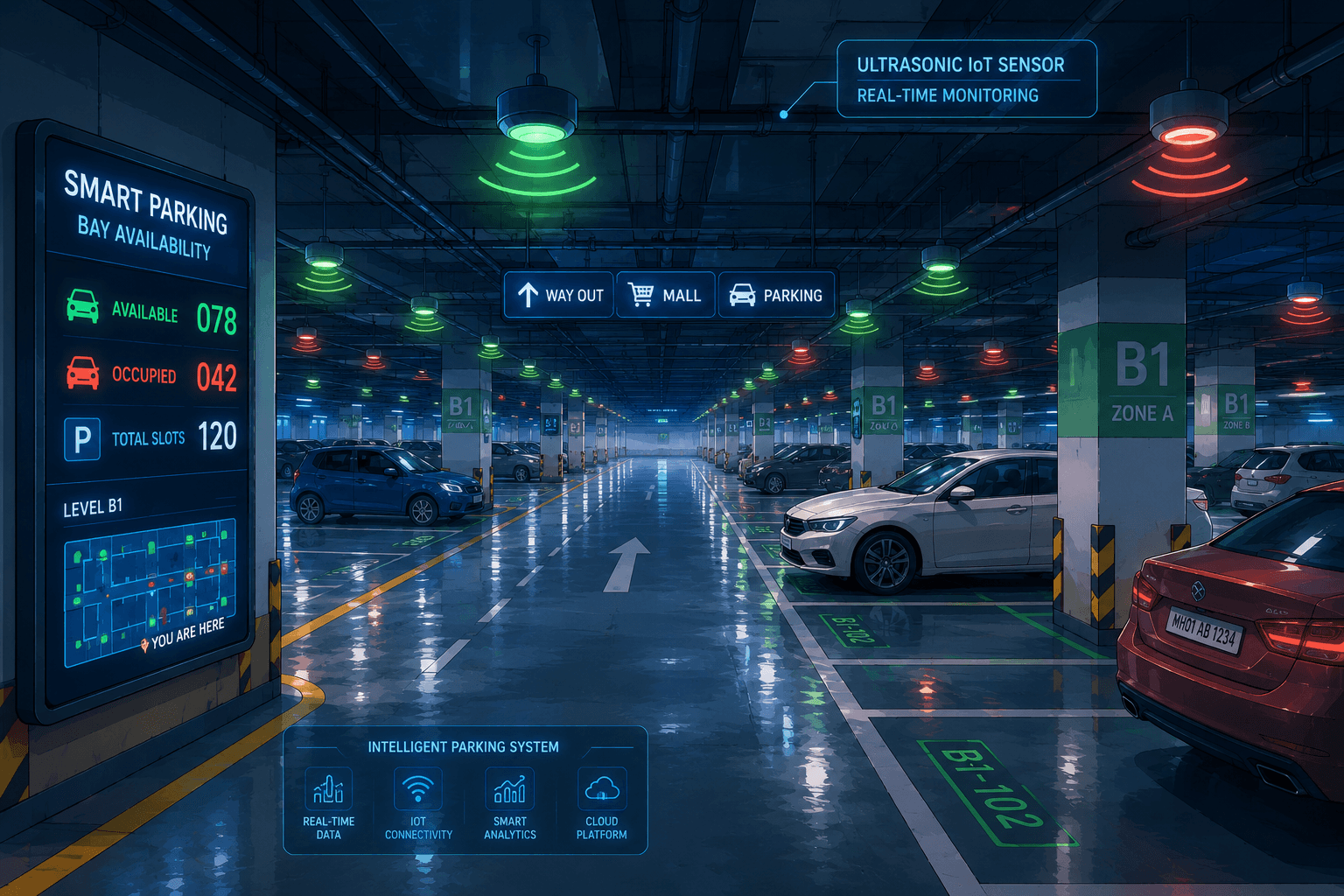
Gate entry counts tell you how many vehicles entered a facility; they do not tell you how many bays are empty right now on Level B2 near the elevator. That distinction drives modern parking economics. Real-time occupancy—knowing which slot is free, which zone is full, and how fast turnover happens—lets operators reduce search traffic, adjust pricing, and prove utilization to retail tenants and municipal planners.
IoT bay sensors are the sensing layer; the dashboard is where data becomes decisions. Parkadda by Multiplexer Solution ingests sensor streams from ultrasonic, magnetic, and camera-based detectors through edge gateways, normalizes state changes, and renders live occupancy views for control rooms, mobile apps, and digital signage. This article explains architecture, pitfalls, and deployment practices for Indian sites from airports to hospital campuses.
The Business Case for Bay-Level Visibility
Studies worldwide link cruising for parking to a measurable share of urban congestion. In Indian CBDs and mall districts, the effect intensifies during festivals and weekend peaks. Occupancy dashboards attack the problem from both sides: guide drivers to free zones via apps or signage, and give operators levers—routing, pricing, valet, or overflow lots—before gridlock forms at ramps.
Who Benefits and How
- Mall operators: Show live availability to tenants; justify parking investments with heat maps.
- Airports: Balance short-term vs long-term lots; staff shuttle routes based on fill rates.
- Hospitals: Prioritize emergency and patient zones; alert when visitor lots approach capacity.
- Municipal corporations: Publish availability in citizen apps for Smart City programs.
- EV charging hosts: Pair bay occupancy with charger status for holistic bay management.
Sensor Technologies and Trade-offs
No single sensor fits every bay type. Selection depends on ceiling height, indoor vs outdoor, power availability, and budget.
Ultrasonic Overhead Sensors
Mounted above each bay, ultrasonic units measure distance to the vehicle roof. Pros: per-bay accuracy, well understood indoors. Cons: deployment cost scales linearly with bays; mounting height must clear tall vehicles including SUVs and vans popular in India.
Magnetic In-Ground Sensors
Detect ferrous mass above the coil. Pros: discreet, good for on-street zones. Cons: civil work for installation; false positives from adjacent heavy vehicles require spacing discipline.
Camera-Based Analytics
Overhead or pole cameras run vision models to classify occupied vs empty regions. Pros: fewer devices per many bays in open lots. Cons: lighting and weather affect accuracy; privacy policies must govern stored imagery.
Parkadda integrates multiple vendor protocols through a gateway abstraction so sites can mix technologies—ultrasonic in basement levels, cameras in surface lots—without fragmenting the dashboard.
Edge Gateways and Data Pipeline
Raw sensor flicker would overwhelm cloud systems if every millisecond crossed the wire. Edge gateways debounce state: empty → occupied → empty with hysteresis to ignore brief drive-throughs. They batch telemetry, attach site and zone metadata, and publish via MQTT or HTTPS to Parkadda’s ingestion service.
Latency and Availability Targets
Dashboard updates for operator decisions should arrive within a few seconds of vehicle stop. Digital signage can tolerate slightly more delay. Define SLAs per use case. Gateways buffer events during connectivity loss and replay with timestamps so historical occupancy charts stay accurate.
Designing the Real-Time Dashboard
Effective dashboards answer questions in order of urgency: Where are we full right now? Where will we be full in thirty minutes? What failed?
Essential Views
- Zone heat map: Color-coded bays or aggregates by floor and section
- Utilization trend: Rolling hourly occupancy vs capacity
- Peak forensics: Compare weekdays, holidays, and weather overlays
- Device health: Offline sensors, low battery, calibration drift
- Anomaly alerts: Occupancy exceeds physical capacity—often misconfiguration or double parking
Parkadda’s operator portal uses responsive layouts so control-room walls and duty manager phones share the same data model. Role-based access hides revenue tiles from facilities staff while exposing device health to maintenance vendors.
Integrating Occupancy with ANPR and Payments
Bay sensors alone do not identify vehicles. ANPR at entries links plates to facility presence. Combined, operators answer: how long has this plate occupied a premium zone? Occupancy plus session data enables overstay enforcement, dynamic pricing for high-demand wings, and validation that monthly pass holders use assigned zones.
Parkadda correlates sensor zone IDs with tariff rules. When utilization crosses thresholds—say ninety percent on Level P1—pricing engines or signage rules trigger without manual intervention, subject to operator policy caps.
Deployment Playbook for Indian Sites
Basement ceilings with low clearance require careful ultrasonic aiming. Dusty surface lots in North India need IP-rated housings and quarterly lens cleaning for cameras. Monsoon leakage in older malls damages in-ground coils—prefer overhead mounts where civil conditions are poor.
Commissioning steps Multiplexer field teams follow:
- Walk the lot with as-built drawings; assign stable bay IDs
- Install sensors; map each to gateway channels in Parkadda
- Calibrate with empty bay reads, then vehicle placements including two-wheelers where allowed
- Run soak tests for 72 hours; tune debounce parameters
- Train operators on alert acknowledgment and maintenance tickets
Data Quality and Governance
Garbage occupancy misroutes drivers and erodes trust. Implement continuous validation: compare sensor counts to ANPR occupancy periodically; flag zones where divergence exceeds tolerance. Document procedures when bays are closed for maintenance—mark bays offline in software so they do not appear as false availability.
Privacy and Retention
Camera-based occupancy must minimize stored video; prefer edge inference sending only occupancy bits. Align retention with municipal and mall IT policies. Citizen-facing apps should show zone availability, not individual vehicle identities.
Analytics Beyond Real-Time
Historical occupancy powers capital planning: justify a new tower wing lot, resize valet staffing, or negotiate BRTS feeder timing with city transport departments. Export APIs feed BI tools; Parkadda supplies standard aggregates—peak hour, average dwell proxy by zone, turnover rate.
Cost and ROI Framing
Sensor projects scale with bay count. Phase deployment: pilot one floor, prove reduced search time and increased retail conversion, then expand. Pair IoT spend with dynamic pricing uplift and enforcement revenue where policies allow. Multiplexer Solution helps build phased business cases for government RFPs and private mall boards.
Why Parkadda for IoT Occupancy
Many vendors sell hardware; fewer deliver end-to-end software that survives Indian operating conditions. Parkadda unifies IoT ingestion, ANPR sessions, payments, and dashboards under Multiplexer Solution’s support model proven in municipal and commercial deployments. Real-time occupancy is not a science project—it is operational infrastructure. Build it once with the right architecture, and operators stop flying blind every Saturday peak.