Blog · 15 October 2025 · Avinash Singh
FASTag Integration in Parking: A Complete Technical Guide
FASTag is no longer limited to national highways—drivers expect RFID toll experience at parking gates, malls, and municipal lots. Integrating FASTag with parking software demands careful lane orchestration, exception handling for unread tags, and finance-grade reconciliation. This guide walks through hardware handshakes, cloud sync patterns, and how Parkadda maps FASTag events to occupancy and revenue reporting.
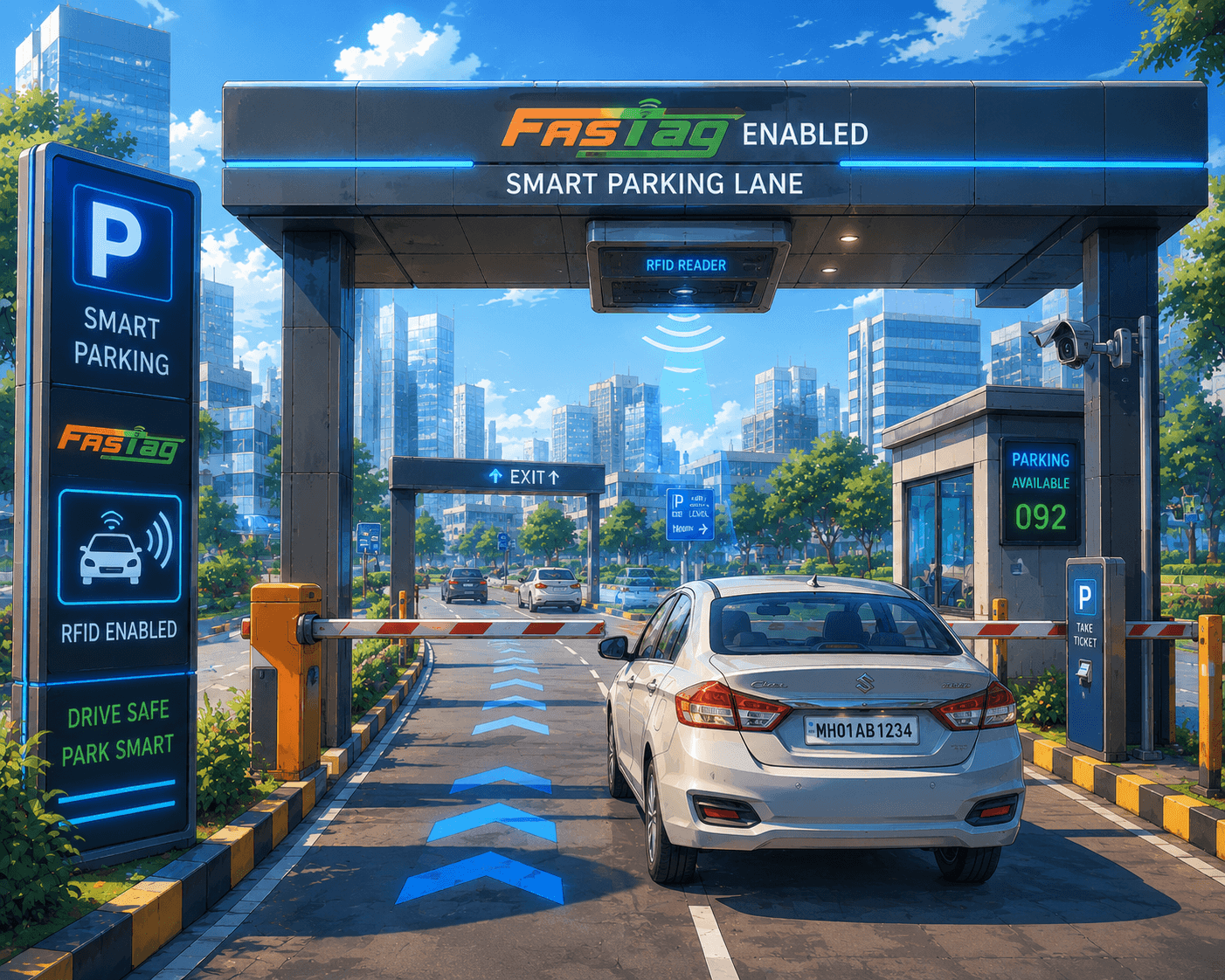
FASTag transformed long-distance travel in India by putting RFID-based toll collection on millions of windshields. Drivers grew accustomed to slowing briefly while a reader debits their linked account. That expectation is now spilling into gated parking: malls, airports, corporate campuses, and municipal corporations want the same touchless experience when a vehicle enters and exits a facility.
Integrating FASTag into parking is technically different from highway tolling. Dwell time varies from minutes to days; tariffs may be flat, hourly, or progressive; multiple payment methods often run on adjacent lanes; and parking operators need session records that tie a tag read to entry time, exit time, and the correct fee. Parkadda by Multiplexer Solution implements FASTag as a first-class payment rail alongside UPI, cards, and prepaid wallets—without treating it as a bolt-on script at the gate.
FASTag Basics Relevant to Parking Integrators
A FASTag is an RFID sticker linked to a prepaid or linked bank account managed through NETC (National Electronic Toll Collection) ecosystem partners. Highway plazas use standardized lane controllers and acquirer switches. Parking deployments typically integrate through certified RFID readers, payment aggregators, or bank APIs that support parking-specific merchant categories and transaction flows.
Key concepts for engineering teams:
- TID and EPC reads: The reader scans the tag; software must map the read to a session, not fire duplicate charges.
- Blacklist and low balance: Highways decline transactions; parking must define fallback—cash lane, UPI QR, or deny entry.
- Idempotency: The same exit trigger must not debit twice if the reader sends duplicate frames.
- Reconciliation files: Acquirers settle on T+1 or similar cycles; finance needs matching reference IDs.
Lane Architecture: Readers, Controllers, and Parking Software
A production FASTag parking lane combines physical components with orchestration logic. An RFID reader mounted on a gantry or pole captures tag data as the vehicle approaches the barrier. A lane controller—often the same industrial PC running ANPR—coordinates reads from FASTag, loop detectors, and cameras. Parkadda’s lane service decides whether to open the barrier, create a pending session, or prompt for alternate payment.
Entry-Only vs Entry-Exit Debit Models
Highway tolls debit once per plaza. Parking commonly uses one of two models:
- Debit on exit: Entry stores tag ID and timestamp; exit calculates fee and initiates NETC debit. This matches hourly and progressive tariffs.
- Flat debit on entry: Suitable for event parking or fixed-duration zones where fee is known upfront.
Parkadda supports both, configured per zone. Exit debit requires reliable pairing when multiple vehicles queue; ANPR cross-check helps when tag reads collide or a tag is unreadable at exit but captured at entry.
Handshaking with NETC and Acquirer APIs
Exact integration paths depend on your acquirer and bank certifications. Typical steps include merchant onboarding for parking MCC, sandbox testing with sample tags, certificate pinning for API calls, and production cutover with limited lanes. Parkadda abstracts acquirer-specific payloads into an internal PaymentAttempt record with states: initiated, authorized, failed, reversed.
Engineering teams should implement:
- Timeout handling when acquirer latency exceeds barrier wait tolerance
- Explicit error codes mapped to operator messages in Hindi and English
- Retry policies only where NETC semantics allow—never blind retry on success
- Webhook or polling for asynchronous settlement confirmations
Testing Matrix Before Go-Live
Validate scenarios beyond the happy path: sufficient balance, insufficient balance, blacklisted tag, unread tag, tag read at entry but not exit, power loss mid-transaction, and network partition between edge and acquirer. Document expected barrier behavior for each. Operators should rehearse manual override so queues do not stall during acquirer outages.
Combining FASTag with ANPR and UPI
Indian parking lanes are hybrid by necessity. A vehicle may enter on FASTag but exit with UPI if balance is low. Monthly pass holders may use plate whitelist without a debit. Visitors without tags pay via QR linked to the ANPR session.
Parkadda maintains a single session object per visit. Payment rails attach as line items rather than disconnected logs. The operator dashboard shows: entry method, exit method, amount, acquirer reference, and any manual adjustment with user ID. This unified model simplifies audits for municipal corporations and mall finance teams alike.
Exception Handling at the Gate
Real lanes are messy. Tags are behind windshields with metallic sunfilm. SUVs mount tags low while readers aim high. Two vehicles stop abreast in wide lanes. Exception workflows define operator experience:
- Unread tag at entry: Route to cashless QR lane or manual booth; do not open barrier on assumption.
- Read at entry, unread at exit: Use ANPR or session lookup to retrieve tag; if still missing, collect via UPI before exit.
- Duplicate read events: Debounce within milliseconds; log raw frames for diagnostics.
- Insufficient balance: Display amount due; offer UPI top-up or one-time payment without blocking queue indefinitely.
Parkadda’s booth tablet UI surfaces these cases with minimal taps so attendants resolve issues in seconds, not minutes.
Reconciliation and Finance Reporting
Parking finance teams care about three matches: sessions vs debits, debits vs bank settlement files, and settlement vs general ledger. Parkadda exports daily reports with acquirer reference numbers, lane IDs, timestamps, and gross amounts. Discrepancy views flag sessions closed in software without a confirmed debit, or debits without matching exit events—often the first sign of reader misalignment or duplicate firing.
Revenue Recognition and GST
Operators must align parking fee invoices with payment mode. FASTag settlements may bundle fees net of acquirer charges. Consult your tax advisor for GST treatment on parking services in your state; software should emit data fields (tariff, cess, invoice number) even if invoicing is external.
Hardware Selection and Installation Notes
Reader frequency, mounting height, and cable shielding matter. Co-locate FASTag readers with loop detectors so software reads tags only when a vehicle is present—reducing phantom reads from adjacent lanes. Use surge protection on outdoor installs. Schedule preventive maintenance to clean antennas and verify firmware.
Multiplexer Solution specifies compatible reader models tested with Parkadda edge services. Field engineers calibrate read zones using tagged test vehicles at multiple speeds and stop positions.
Security and Compliance
Tag IDs and transaction data are financial-grade sensitive. Encrypt API credentials in vaults, rotate keys, restrict operator search to shift needs, and log administrative exports. For government parking, prefer private network paths to acquirer endpoints. Follow RBI and NETC partner guidelines for storage and retention.
Operational KPIs for FASTag Lanes
- Percentage of exits settled via FASTag without manual intervention
- Average debit authorization latency at exit
- Failed debit rate and top failure codes
- Reconciliation variance between Parkadda and acquirer files
- Lane throughput compared to cash-only baseline
Deploying FASTag with Parkadda
Whether you modernize a single mall basement or roll out municipal zones city-wide, FASTag integration is a systems project—not a reader purchase. Parkadda provides lane orchestration, session management, acquirer adapters, operator tools, and dashboards tuned for Indian parking economics. Multiplexer Solution’s integration team supports acquirer certification, on-site commissioning, and hypercare so your FASTag lanes deliver the same trust drivers experience on highways: fast, predictable, and auditable.