Blog · 1 June 2025 · Sanjay Gund
From RFID to Cloud: The Evolution of the Parkadda Platform
Parkadda began as reliable RFID gate control for Indian campuses and events—solve barrier uptime first, software second. Years of field deployments across societies, corporates, hospitals, and government programs expanded it into a cloud platform with ANPR, mobile apps, operator portals, payments, and analytics. This is the story of how Multiplexer Solution evolved Parkadda without breaking the uptime promise that early customers still rely on.
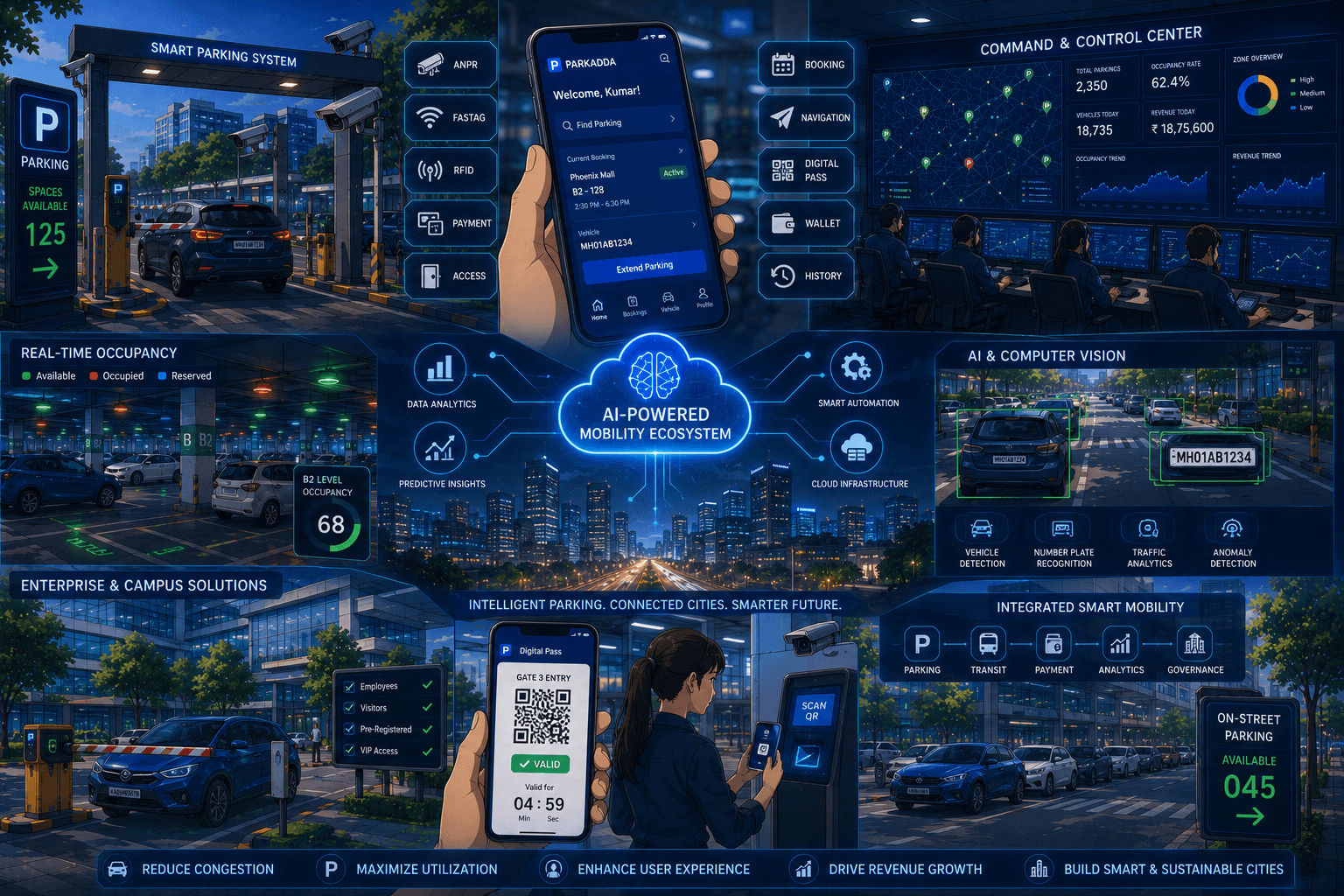
Every software platform has an origin myth. Parkadda’s is practical: Indian parking sites needed gates that opened reliably, logged who entered, and did not require a computer science degree to operate at the booth. Multiplexer Solution started with RFID readers, controllers, and on-premise logic—because that was what societies, corporate campuses, and event venues could deploy quickly without fiber to every pillar.
Over a decade of deployments—from resident welfare associations in Delhi NCR to Smart Srinagar municipal zones—Parkadda grew into a cloud-connected smart parking and mobility platform. The through-line never changed: uptime first, local operating conditions respected, support answered by engineers who commission lanes, not ticket bots alone.
Chapter 1: RFID Gate Control
Early Parkadda installations focused on sticker or card RFID for members and visitors. Readers at boom barriers identified credentialed vehicles; visitors received temporary tags or manual passes. Software ran close to the gate—minimal latency, function during internet outages, simple operator screens.
What We Learned
- Hardware quality dominates user perception—cheap readers cause more tickets than software bugs
- Indian sites mix vendor equipment; abstraction layers matter early
- Booth staff turnover requires UX in Hindi and English with large touch targets
- Logging must be tamper-evident for society managing committees auditing vendors
Chapter 2: Payments and Operator Tools
As UPI adoption exploded, parking could no longer treat payments as a separate cash register. Parkadda added tariff engines, shift reports, and QR flows linked to sessions. Operator portals let remote admins configure zones, passes, and holiday tariffs without site visits.
Corporate campuses demanded integration with HR access systems; hospitals needed ambulance bypass rules; events needed burst capacity and prepaid batches. The platform modularized rules without forking per customer codebase—a lesson learned painfully from one-off scripts in the early years.
Chapter 3: ANPR and Vision at the Lane
RFID alone cannot scale to municipal on-street enforcement or high-throughput commercial lanes where stopping for a tag is unacceptable. Parkadda integrated ANPR pipelines—first as assist to RFID, then as primary identity for government and mall deployments.
Indian plate diversity pushed investment in local training data, edge inference, and hybrid validators. Smart Srinagar and subsequent municipal RFPs validated that Parkadda was no longer “society gate software”—it was city-grade with command centers and finance exports to match.
Chapter 4: Cloud Platform and APIs
On-premise logic remains for barrier interlocks and safety, but authoritative session state, dashboards, mobile apps, and integrations moved to cloud services with regional hosting appropriate to customer IT policies. APIs allow:
- Mobile apps showing availability and digital receipts
- Integration with mall ERP and tenant billing
- Webhook events for enforcement partners
- BI exports for utilization and revenue analytics
Edge gateways sync with conflict resolution when clocks skew or networks partition. The architecture is offline-tolerant, not offline-ignorant—operators still need accurate end-of-day totals.
Chapter 5: IoT Occupancy and FASTag
Modern parking is multimodal at the lane: ANPR, FASTag, UPI, cards, whitelist plates, and bay sensors informing availability. Parkadda ingests IoT occupancy streams for heat maps and combines FASTag acquirer events with session objects for reconciliation.
Each rail attaches to the same session model so finance sees one visit, multiple payment attempts, not disconnected logs. This unification is the platform bet—customers should not buy five vendors and stitch CSV files monthly.
Product Principles That Survived Each Rewrite
Uptime Is a Feature
Releases roll out lane-by-lane with rollback. Critical path code paths—barrier open on validated exit—are tested under simulated load and failure injection. Municipal SLAs embed uptime credits because leaders know citizens film queue failures.
India-First Defaults
Plates, payments, languages, and weather drive requirements global products ignore. Parkadda’s roadmap prioritizes NETC parking flows, state tariff quirks, and operator training kits for mixed literacy booths.
Field Support, Not Just Licenses
Multiplexer engineers commission sites, tune cameras, and sit through first festival peaks. Software without deployment discipline fails Smart City programs; we sell outcomes.
Who Uses Parkadda Today
- Residential societies and townships with member RFID and visitor workflows
- Corporate campuses linking parking to access control
- Hospitals balancing patient, staff, and visitor zones
- Malls and mixed-use developments with ANPR and dynamic tariffs
- Municipal corporations including Smart Srinagar smart parking zones
- Events and stadiums needing burst entry and prepaid batches
Technology Stack Evolution (High Level)
Early stacks were monolithic services on local industrial PCs. Today Parkadda uses containerized edge services, message queues for telemetry, managed databases with encryption, and CI/CD pipelines that ship model updates with governance. The specifics evolve; the architecture pattern—edge for safety and speed, cloud for truth and analytics—remains stable.
Security and Compliance Maturity
As government deployments grew, so did requirements: role-based access, audit logs, encrypted transport, vulnerability patching SLAs, and data retention policies aligned to municipal law. Parkadda’s security model treats plate and payment data as sensitive by default, not as debug logs.
What’s Next
Parking connects to broader urban mobility: EV charging bay management, congestion pricing pilots, integration with public transit apps, and predictive occupancy using historical IoT feeds. Parkadda’s platform roadmap invests in open APIs and partner marketplaces so cities adopt innovation without vendor lock-in to proprietary hardware alone.
Multiplexer Solution also expands partner training—certifying local integrators who install lanes to Parkadda standards—so scale across India does not bottleneck on one company’s field headcount.
From Gates to Platform
Customers who bought RFID reliability years ago now run ANPR municipal lanes on the same platform family. That continuity matters: they are not rip-and-replaced every budget cycle. Parkadda’s evolution is proof that Indian parking technology can mature without importing bolt-on systems that fail in local conditions.
If you are evaluating smart parking partners, ask about the journey—not only the demo. Platforms forged in live Indian lanes, with government and commercial references, outperform slideware built elsewhere. Parkadda is Multiplexer Solution’s answer: start at the gate, grow to the cloud, never forget who keeps the barrier working at 9 PM on a rainy Saturday.